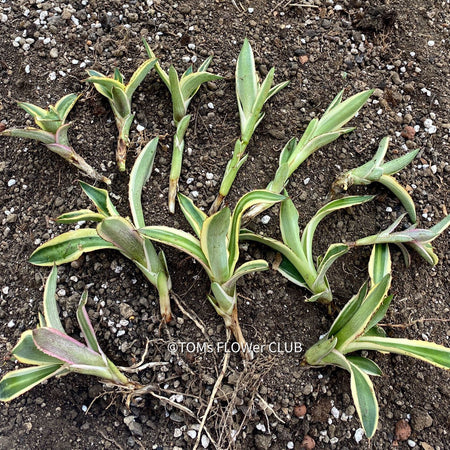
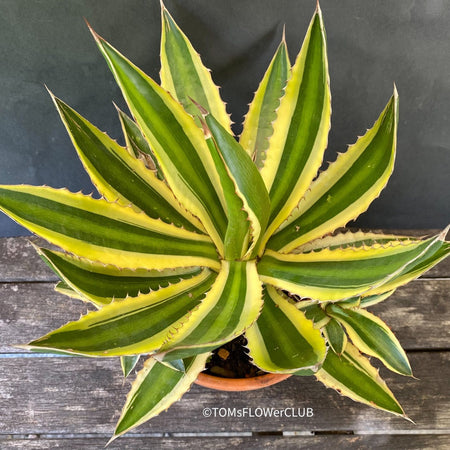
Agave Lophantha Variegata Quadricolor
from CHF 8.00

If somebody asked me which plant group best combines beauty, resilience and botanical drama, my answer would almost certainly be Agave.
Agaves are not merely succulents. They are living sculptures that evolved to survive some of the harshest environments in the Americas. Their geometric rosettes, impressive leaf structures and remarkable flowering behaviour make them some of the most rewarding plants a collector can grow.
However, there is one important truth that every prospective agave owner should understand:
Agaves are not typical houseplants.
Many species can survive indoors, but very few truly thrive without abundant sunlight. If you cannot offer an agave a bright south-facing window, conservatory or outdoor summer location, another plant group may be a better choice.
At TOMs FLOWer CLUB, we often tell customers that agaves do not want to survive—they want to live. And to live well, they need sunshine.
Agaves belong to a fascinating group of succulent plants native primarily to Mexico, although species can also be found throughout the southwestern United States, Central America, parts of South America and the Caribbean.
Over thousands of years, these plants evolved remarkable adaptations to drought.
Their thick leaves store water.
Their waxy surfaces reduce moisture loss.
Their compact rosette shape protects the growing centre from excessive heat.
Many species are capable of surviving extended periods without rainfall, making them exceptionally well adapted to dry climates.
Yet despite their rugged appearance, many agaves display an extraordinary elegance that makes them highly sought-after collector plants.
One of the reasons I admire agaves so much is their patience.
Unlike many fast-growing houseplants, agaves develop gradually. Every leaf contributes to the plant's final architecture. Every year adds character and symmetry.
Many people initially perceive slow growth as a disadvantage.
Collectors know better.
A beautiful agave is not created in a single season.
The finest specimens often represent years, sometimes decades, of careful cultivation.
The reward is a plant that becomes increasingly impressive with age rather than declining after a short decorative phase.
If there is one care recommendation that deserves repeating, it is this:
Give your agave as much sun as possible.
Agaves evolved under intense sunlight.
When light levels are insufficient, the plant begins to stretch.
Leaves become longer.
Growth becomes weaker.
The compact rosette loses its natural symmetry.
Many beginners mistakenly believe their agave requires more water or fertiliser when the real problem is lack of sunlight.
In my experience, a sunny balcony, terrace or south-facing position during the growing season will often achieve more than any fertiliser programme.
Most agave problems originate below the soil surface.
Specifically: around roots that remain too wet.
Agaves dislike standing in water.
They dislike dense soils.
They dislike permanently moist conditions.
What they love is drainage.
A well-drained substrate allows oxygen to reach the roots and reduces the risk of rot.
At TOMs FLOWer CLUB, we cultivate our agaves in permeable growing media designed to dry efficiently after watering.
The principle is simple:
Water thoroughly.
Allow the substrate to dry completely.
Water again only when necessary.
Many collectors eventually discover that occasional underwatering is far less dangerous than chronic overwatering.
One of the most overlooked aspects of agave cultivation is winter dormancy.
During the darker months of the year, especially in Europe, agaves benefit greatly from a cool resting period.
Ideally:
Why?
Because the combination of low temperatures and wet soil is one of the fastest ways to lose an agave.
The plant's metabolism slows dramatically during winter.
Roots absorb less water.
Excess moisture remains trapped in the substrate.
Rot becomes a serious risk.
Many experienced growers lose fewer plants by watering less, not more.
One lesson that almost every agave grower learns eventually is that plants can get sunburned.
This surprises many people.
How can a desert plant be damaged by sunlight?
The answer lies in adaptation.
After spending winter indoors or in storage, agaves become less accustomed to intense ultraviolet radiation.
Moving them directly into full spring sunshine can result in leaf damage within days.
Always allow plants to reacclimatise gradually.
One to two weeks of partial protection often prevents permanent scarring.
Think of it as giving the plant time to put its sunglasses back on.
Many people assume agaves are strictly tropical plants.
That is not entirely true.
Several species display remarkable cold tolerance.
Examples include:
Under suitable conditions, some can tolerate temperatures approaching -15°C or even lower.
However, cold tolerance is only part of the equation.
Winter moisture is often a greater threat than cold itself.
This is why experienced growers often refer to keeping agaves "dry-footed and dry-headed."
Protection from excessive rain and snow is frequently more important than protection from freezing temperatures.
If there is one fact that captures people's imagination, it is this:
Most agaves flower only once in their lifetime.
This phenomenon is called monocarpy.
For years—sometimes decades—the plant stores energy.
Then, at maturity, it produces a spectacular flowering spike that may reach several metres in height.
The flowering event is one of the most dramatic displays in the plant kingdom.
After flowering, the mother plant dies.
At first glance this seems tragic.
In reality, it is an extraordinary evolutionary strategy.
The plant often produces hundreds or thousands of seeds.
Many species also generate offsets or "pups" that continue the next generation.
Nature sacrifices one individual to ensure the future of many.
One of the world's most famous alcoholic beverages owes its existence to a single agave species.
Tequila is produced from Agave tequilana, commonly known as the Weber Blue Agave.
The plant's sugars are harvested and fermented before distillation.
While most collectors will never turn their agaves into tequila, this connection illustrates how deeply these plants are woven into the cultural history of Mexico.
There are easier plants.
There are faster-growing plants.
There are certainly cheaper plants.
Yet few offer the combination of structure, resilience and personality found in agaves.
They reward patience.
They encourage observation.
They teach restraint.
And perhaps most importantly, they become more beautiful with time.
At TOMs FLOWer CLUB, our agave collection reflects exactly these qualities: strong plants, cultivated for long-term health rather than rapid production, and selected because they deserve a place in serious plant collections.
Only if sufficient sunlight is available. Most species require far more light than typical houseplants.
Water thoroughly and then allow the substrate to dry completely before watering again.
This is usually a sign of insufficient light.
Some species can tolerate significant frost, provided they remain relatively dry during winter.
Most agaves are monocarpic. They flower once, produce seeds or offsets and then complete their life cycle.
Agave tequilana, also known as Weber Blue Agave.
from CHF 8.00


from CHF 78.00


from CHF 17.00


CHF 44.00


from CHF 35.00


CHF 10.00
CHF 16.00


CHF 104.00


from CHF 26.00


CHF 20.00

from CHF 52.00